रूलेट प्रणालीको इतिहास
मानिसहरूले बाजीको रकम बदल्ने नियम लेखेको दुई शताब्दी।
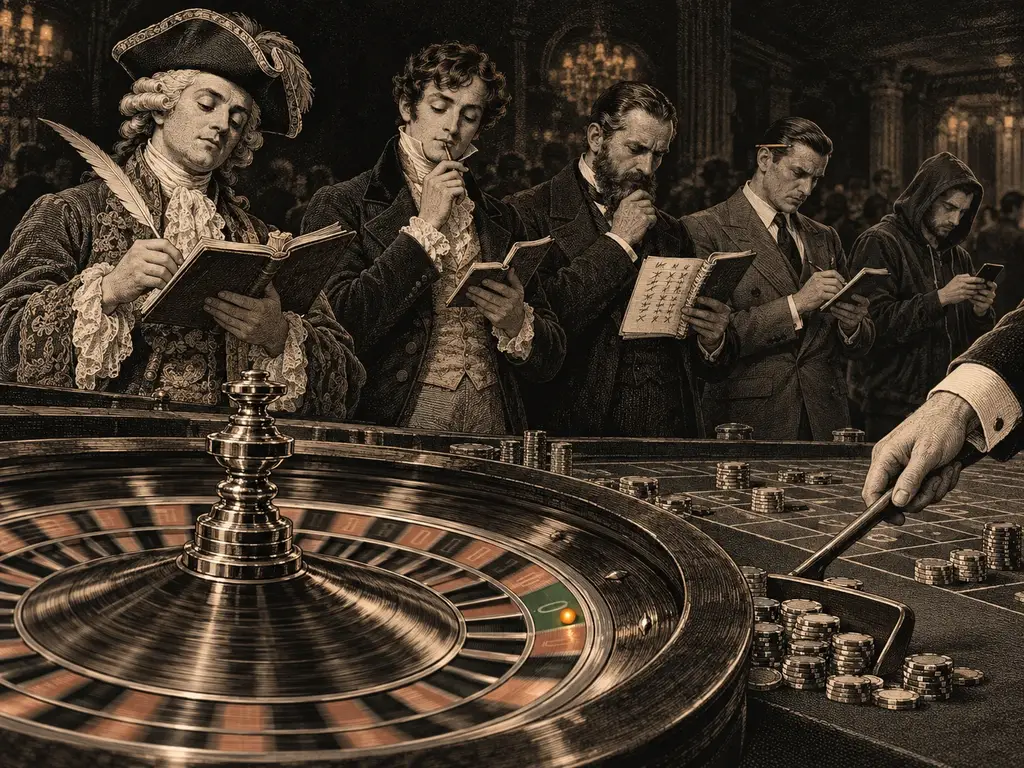
Martingale 18औँ शताब्दीको हो; D’Alembert ले यसको समर्थन नगरे पनि प्रणालीको नाम उनकै नाममा छ; Labouchère भिक्टोरियन राजनीतिज्ञको रुचि थियो। त्यतिबेला पनि तीमध्ये कुनै चलेन।
Martingale
The 1762 Académie française dictionary records martingaleरणनीतिMartingaleहरेक हारपछि बाजी दोब्बर गर्ने प्रगति प्रणाली। यसले के गर्छ र के गर्दैन भन्नेका लागि रणनीति खण्ड हेर्नुहोस्।पूरै पढ्नुहोस् → as a gambling term for staking what has been lost. Its 1878 edition explicitly describes doubling after a loss and also uses the word more broadly for betting schemes. These entries document usage; they do not identify a single inventor.
Today the familiar doubling progressionरणनीतिप्रगति प्रणालीअघिल्ला नतिजाका आधारमा बाजीको रकम बदल्ने कुनै पनि नियम। ऋणात्मक प्रगति प्रणालीले हारपछि बढाउँछ, सकारात्मकले जितपछि।पूरै पढ्नुहोस् → aims to recover previous losses and gain one starting unitपैसाएकाइप्रणाली वा खेलाडीले प्रयोग गर्ने आधार बाजीको रकम। प्रगति प्रणाली एकाइमा वर्णन हुन्छन् ताकि कुनै पनि रूलेट टेबलमा लागू होऊन्।पूरै पढ्नुहोस् → when a win arrives. A finite bankrollपैसाखेल कोषखेलका लागि छुट्याइएको कुल रकम। खेल कोष व्यवस्थापन भनेको हरेक बाजी र हरेक सत्रमा त्यसको कति जोखिममा राख्ने निर्णय हो।पूरै पढ्नुहोस् → or table limitरूलेट टेबलरूलेट टेबल सीमाअनुमति भएको न्यूनतम र अधिकतम बाजी। अधिकतमले दोब्बर पार्ने प्रगति प्रणाली रोक्छ।पूरै पढ्नुहोस् → can stop the sequence first. The Strategy section shows how those limits affect a session.
D’Alembert
The progression bearing d’Alembert’s name raises the stake by one unit after a loss and lowers it after a win. The name alone does not prove who devised or endorsed the betting rule.
Its mathematical issue is straightforward: on independent spinsगणितस्वतन्त्र घुमाइविगत जे भए पनि हरेक घुमाइको सम्भाव्यता उस्तै हुन्छ। यस साइटका हरेक गणनाको आधार।पूरै पढ्नुहोस् →, a run of one outcome does not make the opposite outcome due. A famous namesake does not change that assumption or the payoutपैसाजितको भुक्तानीजितेको बाजीको, फिर्ता गरिएको बाजी रकमभन्दा माथिको भुक्तानी। “X to 1” ले बाजी रकम अलग्गै फिर्ता हुन्छ र बाजी रकमको प्रत्येक एकाइमा X एकाइ शुद्ध जित हुन्छ भन्ने जनाउँछ।पूरै पढ्नुहोस् →.
Labouchère
The cancellation system uses a list of numbers to determine the next stake. A win removes entries and a loss adds an entry; the Strategy section sets out the rules and examples. Historical stories about its namesake should be distinguished from evidence that the method creates an advantage.
A sequence may clear with a profit, but a losing run can leave a growing list and larger required stakes. How often it clears depends on the starting list, bankroll, limits and stopping rule. There is no universal success percentage.
20औँ शताब्दी
A simulation can show how a specified system behaves under a chosen wheel model. It cannot test every possible rule, and a finite run need not return exactly the theoretical house edgeगणितहाउस एजहरेक बाजीको रकमबाट क्यासिनोले औसतमा राख्ने अंश: युरोपेली रूलेटमा 2.70%।पूरै पढ्नुहोस् →.
For independent uniform single-zeroपाङ्ग्राशून्यएउटै हरियो खोप जसलाई कुनै समान-रकम, दर्जन वा स्तम्भ बाजीले छोप्दैन; हाउस एजको स्रोत। अर्को नाम: एकल शून्य, 0।पूरै पढ्नुहोस् → spins with standard full-loss-on-zero payouts, each unit staked has expected net return −1/37. For a bounded session whose stakes are chosen using information available before each spin, adding the conditional expectations gives expected lossगणितअपेक्षित घाटाअपेक्षित मान गुणा कुल लगाइएको रकम; सत्र वा अवधिमा औसत गुम्ने रकम।पूरै पढ्नुहोस् → equal to 1/37 of expected turnoverपैसाकुल बाजी रकमसत्र वा अवधिमा लगाइएको कुल रकम, फेरि बाजी लगाइएका जित समेत। अर्को नाम: ह्यान्डल, एक्शन।पूरै पढ्नुहोस् →. Stopping or changing stakes can change the distribution of results, but not create positive expectation under those assumptions. Other payouts, such as la partageनियमLa Partageफ्रान्सेली नियम: शून्य आएमा समान-रकम बाजीको आधा रकम फिर्ता हुन्छ। यसले ती बाजीको हाउस एज 1.35% मा आधा पार्छ।पूरै पढ्नुहोस् →, need their own calculation.
ती किन बाँच्छन्
A demonstration can end in profit without showing that the method has an edge. Some rules favor frequent small wins at the cost of occasional large losses; others do the reverse. The proportions depend on the exact rules and limits.
When comparing systems, look at all completed sessions, total stakes, losses and stopping conditions. A selected winning example leaves out the information needed to assess the claim.
| प्रणाली | शताब्दी | यसले गर्छ भन्ने विश्वास गरिएको कुरा |
|---|---|---|
| Martingale | 18औँ | दोब्बर लगाएर जित सुनिश्चित गर्ने |
| D’Alembert | 18औँ–19औँ | जित र हारको सन्तुलन उपयोग गर्ने |
| Labouchère | 19औँ | रेखाको कुल सुनिश्चित गर्ने |
| Fibonacci | 19औँ–20औँ | नरम Martingale |
| Paroli | 19औँ–20औँ | जितको शृङ्खला पछ्याउने |
| क्षेत्र प्रणाली | 20औँ | पाङ्ग्राको लेआउट उपयोग गर्ने |
बिक्रीका लागि प्रणाली
Systems have also been sold with elaborate names and entry rules. The examples below illustrate the arithmetic of specific rules; they are not evidence of who first invented or marketed them. Waiting for a pattern does not alter the next independent spin’s probabilities.
| प्रणाली | विचार | वास्तवमा के हुन्छ |
|---|---|---|
| Phase One | पाँच रातापछि 5, 25, 70, 200, 500 र 1,000 एकाइको क्रममाप कालोमा बाजी लगाउने | छैटौँ घुमाइमा पनि रातो 18/38 नै हुन्छ; दोहोरो-शून्य पाङ्ग्रामा लगभग 47 मा 1 पर्ने लगातार छ हारले 1,800 एकाइ घाटा हुन्छ |
| शून्यको प्रतीक्षा | 0 वा 00 नआएका 40 घुमाइ पर्खने, त्यसपछि दुवैमा बाजी लगाउने र प्रत्येक नआएपछि एकाइ थप्ने | On independent uniform double-zero spins, both zeros miss 40 times with probability (36/38)^40 ≈ 11.50%. The next hit probability remains 2/38. With one additional unit on each zero after each miss, ten losses cost 110 units; a hit on spin eleven nets 264 units overall. |
| Favored 5 | पाँच अङ्क दोहोरिउन्जेल पर्खने, त्यसपछि तिनमा बाजी लगाउने | घुमाइको हरेक क्रममै दोहोराइ हुन्छ; मर्मत गरिएको पाङ्ग्रामा तिनले केही पूर्वानुमान गर्दैनन् |
| ROL / BEH घुम्ती | रातो, बिजोड, न्यून र कालो, जोर, उच्च हुँदै घुम्ने स्थिर समान-रकम बाजी | स्वतन्त्र बाजीको शृङ्खला, प्रत्येकमा पूरा हाउस एज |
| Bartschelly को “Guaranteed” प्रणाली | अन्त्यमा थप्नुको सट्टा प्रत्येक हारलाई भएका अङ्कमा फैलाउने Labouchère | रेखा कहिल्यै लामो हुँदैन; बाजीको रकम जसरी पनि बढ्छ |
प्रणाली नभएको एक
रोक्ने नियम: कति हार्ने वा जित्ने भन्ने पहिल्यै तय गर्ने र छोड्ने। यिनलाई प्रायः प्रणालीको भागका रूपमा बेचिन्छ र कुल बाजी रकम घटाउने भएकाले केही गर्ने एकमात्र भाग यही हो। यिनको कुनै नामदाता छैन, जुन उपयुक्त छ।
प्रश्नहरू
Martingale, एक शताब्दी वा अझ बढी पुरानो। हारपछि दोब्बर लगाउनु सबैलाई आउने पहिलो विचार हो।
दुर्घटनावश D’Alembert सबैभन्दा नजिक आए। Pascal, Fermat, Huygens, Bernoulli र Laplace सबैले ती किन असफल हुन्छन् भनेर व्याख्या गरे।
किनभने धेरै सत्र जित्छन्, र जितको सत्रको भिडियो बनाउन सस्तो पर्छ।
हास्य-विराम
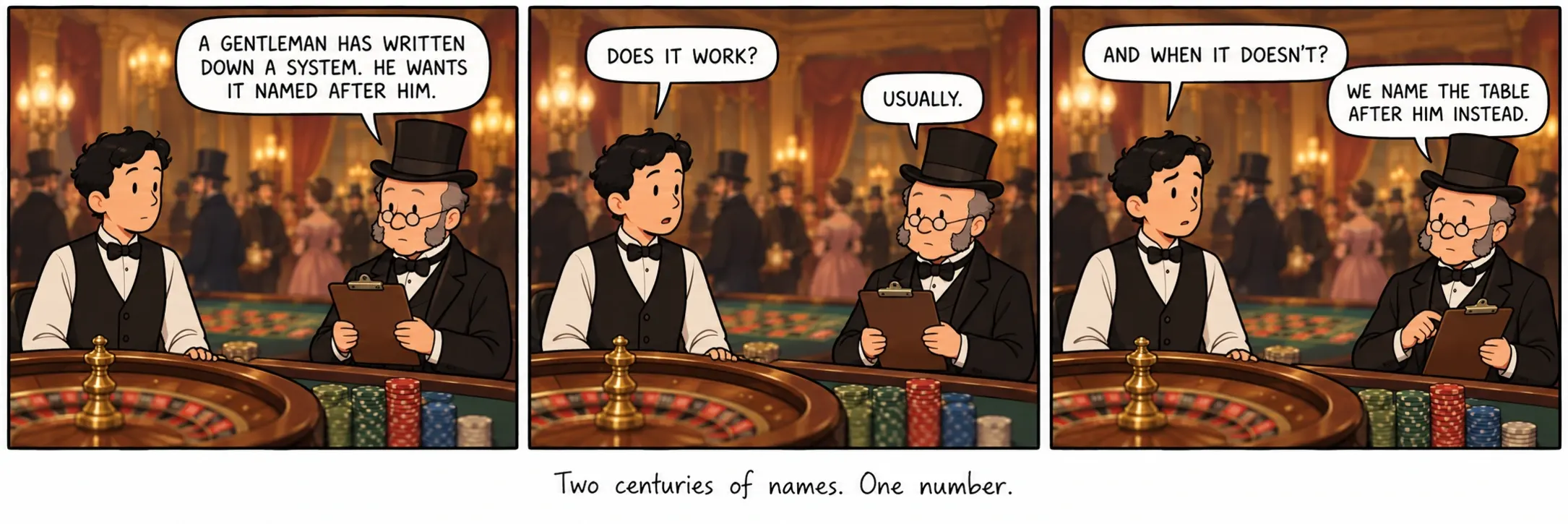
दुई शताब्दीका नाम। एउटै सङ्ख्या।
स्रोतहरू
- Thorp, E. O. “Optimal gambling systems for favorable games.”
- Thorp, E. O. The Mathematics of Gambling.
- Doob, J. L. “Note on probability.”
- Halmos, P. R. “Invariants of certain stochastic transformations: the mathematical theory of gambling systems.”
- d’Alembert, J. “Croix ou pile.”
- Schwartz, D. G. Roll the Bones: The History of Gambling.
- Kavanagh, T. M. Dice, Cards, Wheels: A Different History of French Culture.
- Bollman, M. Mathematics of the Big Four Casino Table Games: Blackjack, Baccarat, Craps, & Roulette.
- Académie française, martingale, 1762
- Académie française, martingale, 1878