केली मापदण्ड र रूलेट
केली मापदण्डले गणितीय लाभ भएको बाजी लगाउनेलाई कति रकम लगाउने भन्छ। रूलेटका लागि यसको स्पष्ट उत्तर छ: केही पनि होइन।

केली बाजी रकम = गणितीय लाभ / अड्स। ऋणात्मक गणितीय लाभमा सूत्रले ऋणात्मक अंश दिन्छ, जसको अर्थ बाजी नलगाउनु हो। मापदण्ड अझै पनि पक्षपात पाङ्ग्राका खेलाडीले आफ्नो बाजीको रकम किन त्यसरी तय गर्थे, र अरू सबैले बजेटअनुसार किन तय गर्नुपर्छ, बुझ्न उपयोगी छ।
मापदण्ड
John Kelly (1956) asked how a gambler with a known edge should size bets to maximize long-run growth of the bankrollपैसाखेल कोषखेलका लागि छुट्याइएको कुल रकम। खेल कोष व्यवस्थापन भनेको हरेक बाजी र हरेक सत्रमा त्यसको कति जोखिममा राख्ने निर्णय हो।पूरै पढ्नुहोस् →. The answer, for a bet paying b to 1 with win probabilityगणितसम्भाव्यतानतिजा हुने मौका, 0 देखि 1 वा 0% देखि 100% सम्म। एउटा सङ्ख्या: 1/37 = 2.70%।पूरै पढ्नुहोस् → p and loss probability q = 1 − p, is to stake the fraction f* = (bp − q) / b of the bankroll. Positive f* means bet that fraction; zero or negative means do not bet. Kelly worked at Bell Labs, and his paper, “A new interpretation of information rate”, set the problem in Claude Shannon’s theory of information: a gambler who gets tips over a noisy line, at fair odds, can grow the bankroll at best at the rate the line carries information. This is a growth objective under a probability model, not a promise to finish ahead after a particular number of bets. A spending limit, finite deadline or payoutपैसाजितको भुक्तानीजितेको बाजीको, फिर्ता गरिएको बाजी रकमभन्दा माथिको भुक्तानी। “X to 1” ले बाजी रकम अलग्गै फिर्ता हुन्छ र बाजी रकमको प्रत्येक एकाइमा X एकाइ शुद्ध जित हुन्छ भन्ने जनाउँछ।पूरै पढ्नुहोस् → cap changes the decision problem.
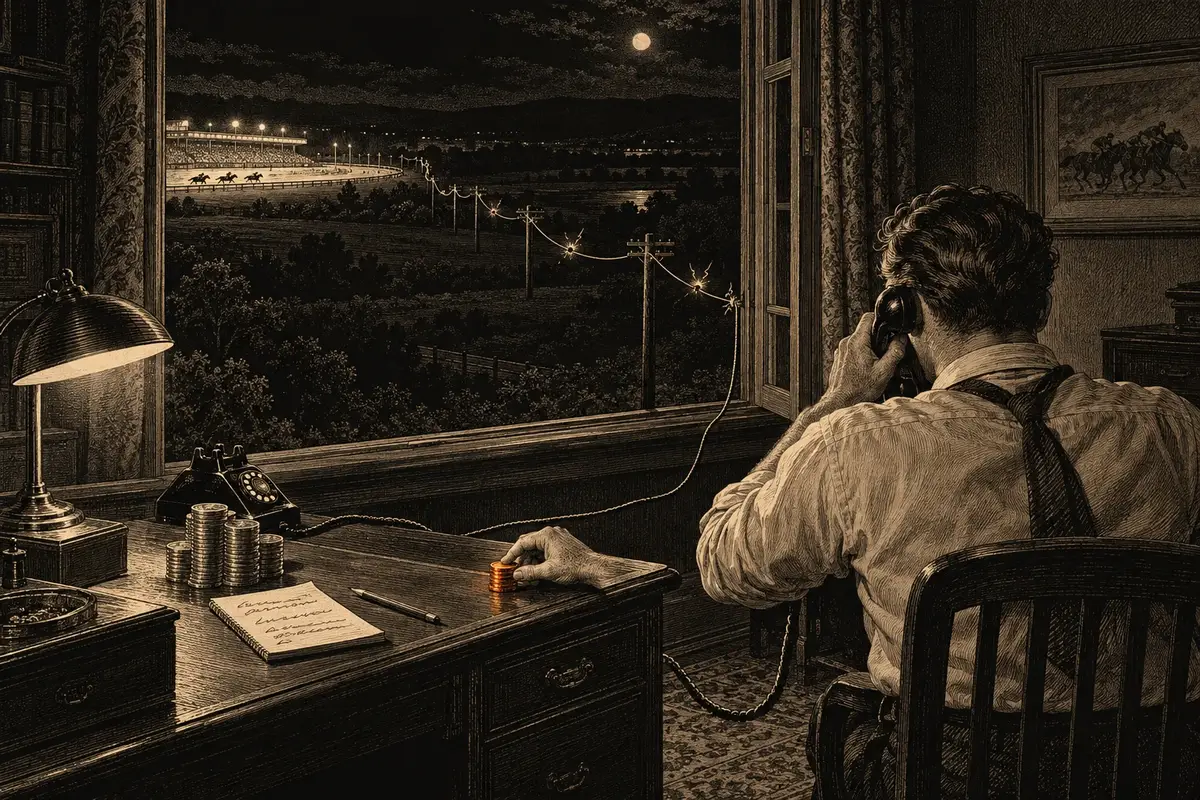
रूलेटमा केली बाजी
For redबाजीरातो18 रातो सङ्ख्यामाथिको समान-रकम बाजी। फ्रान्सेली: rouge।पूरै पढ्नुहोस् →: b = 1, p = 18/37, q = 19/37; f* = (18/37 − 19/37)/1 = −1/37. For a straight upबाजीस्ट्रेट अपएउटै सङ्ख्या, 35:1 भुक्तानी।पूरै पढ्नुहोस् →: b = 35, p = 1/37, q = 36/37; f* = (35/37 − 36/37)/35 = −1/1295. Every standard bet gives a negative Kelly fraction, because every bet has a negative edge, and the growth-optimal stake is zero. Kelly betting on roulette is a formal way of saying what the house-edge page says: no positive stake maximizes expected logarithmic growth when the bet has negative expectation. A particular session can still end in profit. La partageनियमLa Partageफ्रान्सेली नियम: शून्य आएमा समान-रकम बाजीको आधा रकम फिर्ता हुन्छ। यसले ती बाजीको हाउस एज 1.35% मा आधा पार्छ।पूरै पढ्नुहोस् → needs a separate three-outcome calculation: a win, a full loss or a half-loss on zeroपाङ्ग्राशून्यएउटै हरियो खोप जसलाई कुनै समान-रकम, दर्जन वा स्तम्भ बाजीले छोप्दैन; हाउस एजको स्रोत। अर्को नाम: एकल शून्य, 0।पूरै पढ्नुहोस् →. Its expected log growth also falls as the stake increases from zero.
| बाजी | b | p | f* = (bp − q)/b | अर्थ |
|---|---|---|---|---|
| रातो, युरोपेली | 1 | 18/37 | −0.027 | बाजी नलगाउनु |
| रातो, la partage | तीन नतिजा | 18/37 जित; 1/37 आधा हार | द्विआधारी सूत्र लागू हुँदैन | 0% वृद्धि-इष्टतम बाजी रकम |
| स्ट्रेट अप | 35 | 1/37 | −0.00077 | बाजी नलगाउनु |
| 1/30 कक्षमा स्ट्रेट अप (पक्षपाती) | 35 | 1/30 | +0.0057 | खेल कोषको 0.57% लगाउनु |
| 1/25 कक्षमा स्ट्रेट अप | 35 | 1/25 | +0.0126 | खेल कोषको 1.26% लगाउनु |
केली कहाँ लागू भयो
Suppose a pocketउपकरणखोपरोटरमा रहेका 37 क्रमाङ्कित खण्डमध्ये एक। अर्को नाम: स्लट, कप।पूरै पढ्नुहोस् → really has a stable, known probability of 1 in 30 and pays 35 to 1. The Kelly fraction is 0.57%: about $57 from a $10,000 bankroll. Under independent spinsगणितस्वतन्त्र घुमाइविगत जे भए पनि हरेक घुमाइको सम्भाव्यता उस्तै हुन्छ। यस साइटका हरेक गणनाको आधार।पूरै पढ्नुहोस् → and exact fractional staking, the geometric growth factor over 1,000 spins is about 1.7. Expected bankroll grows faster because rare large wins pull up the average. These are model calculations, not evidence that any named historical player used Kelly or achieved this result.
सामान्य र औसत
The gap between the typical bankroll and the average one is wide. Take a pocket that hits 1 time in 25, a hypothetical edge of 44% per unitपैसाएकाइप्रणाली वा खेलाडीले प्रयोग गर्ने आधार बाजीको रकम। प्रगति प्रणाली एकाइमा वर्णन हुन्छन् ताकि कुनै पनि रूलेट टेबलमा लागू होऊन्।पूरै पढ्नुहोस् → staked. Kelly stakes 1.26% of the bankroll on it. After 1,000 spins the typical bankroll has grown about 11.5 times, while the average, pulled up by a few very lucky runs, has grown about 249 times. Betting more than Kelly raises the average and lowers the typical result: at twice the Kelly stake the typical bankroll only doubles, and by two and a half times the Kelly stake it shrinks, although every bet still carries a 44% edge. In this example, half-Kelly retains about 78% of the expected log growth. This fraction depends on the probabilities and payout.
| बाजी रकम, केलीको अंश | बाजी रकम, खेल कोषको % | 1,000 घुमाइपछिको सामान्य खेल कोष |
|---|---|---|
| ½ | 0.63% | × 6.7 |
| 1 | 1.26% | × 11.5 |
| 1½ | 1.89% | × 7.4 |
| 2 | 2.51% | × 2.2 |
| 2½ | 3.14% | × 0.38 |
| 3 | 3.77% | × 0.04 |
गणितीय लाभ अनुमान मात्र हुँदा
Kelly uses the true probabilities, but a player usually has only estimates. Selecting the busiest pocket from a past record creates a selection problem: even a fair wheel has a busiest pocket. Its observed rate can overstate its future probability. Choosing the stake from that same record compounds the error. An independent follow-up sample helps test a proposed bias (see How to Detect Roulette Wheel Bias). Reducing the calculated fraction reduces exposure, but cannot turn a false edge into a real one.
गणितीय लाभ भएका मानिसहरू
Haghani and Dewey (2016) studied 61 participants given $25 and 30 minutes to bet on a simulated coin with a disclosed 60% chance of heads. The payout cap was $250; its value was revealed when a proposed winning bet would reach it. Their reported 21% success category included balances of at least $200, while the 28% “bust” category meant less than $2, not necessarily zero. Eighteen participants bet their entire balance on one flip. The uncapped Kelly fraction is 20%, but the cap and deadline change the optimization problem. The experiment illustrates how stake choices matter even with a known advantage; it does not establish one best strategy for every objective.
सट्टामा के प्रयोग गर्ने
गणितीय लाभ नभए रकम तय गर्नु वृद्धि होइन, बजेटको प्रश्न हो: बाजी रकम = प्रति घुमाइ खर्च गर्न तयार रकम, जुन प्रतिघण्टा बजेट र रूलेट टेबलको गतिबाट निस्कन्छ (खेल कोष व्यवस्थापन पृष्ठ)। साधारण खेलाडीका लागि केलीको योगदान यसको जवाफको स्पष्टता हो: शून्य। शून्यभन्दा बढी लगाइएको हरेक रकम खेल्ने मूल्य हो, तपाईंले रोजेको, कुनै सूत्रले इष्टतम नबनाएको।
अंशात्मक केली र “मनी म्यानेजमेन्ट” सम्बन्धी टिप्पणी
Betting a fixed percentage of the current bankroll is proportional staking: the stake rises after wins and falls after losses. Flat bettingरणनीतिस्थिर बाजीहरेक घुमाइमा उही रकम बाजी लगाउनु। हरेक प्रगति प्रणालीसँग तुलना गरिने आधाररेखा।पूरै पढ्नुहोस् → instead keeps the cash stake fixed. Neither creates an edge on ordinary roulette. With infinitely divisible stakes and a fraction below 100%, proportional staking never reaches exactly zero in finitely many losses, but the balance can become arbitrarily small. Real table minimums can prevent further play much sooner. The growth-optimal fraction remains zero.
सूत्र
प्रश्नहरू
Only when the actual probabilities, payouts and conditions give a credible positive advantage. Standard bets on an unbiased wheel have no such advantage.
Using half the calculated fraction reduces exposure to errors in the estimated edge. The familiar three-quarters-growth rule is an approximation for small advantages, not a universal identity. It does not protect against an edge that does not exist.
होइन। केलीले गणितीय लाभ भएको अवस्थामा वृद्धि इष्टतम बनाउँछ। खेल कोष व्यवस्थापनले लाभ नभएको अवस्थामा खर्च नियन्त्रण गर्छ।
गणितसँग रमाइलो
पहिले यी आफैँ प्रयास गर्नुहोस्। हरेक समाधान भित्र तह लगाइएको छ; तयार भएपछि खोल्नुहोस्।
Suppose a hypothetical bet on one number has a known 44% edge under standard payoutsपैसाजितको भुक्तानीजितेको बाजीको, फिर्ता गरिएको बाजी रकमभन्दा माथिको भुक्तानी। “X to 1” ले बाजी रकम अलग्गै फिर्ता हुन्छ र बाजी रकमको प्रत्येक एकाइमा X एकाइ शुद्ध जित हुन्छ भन्ने जनाउँछ।पूरै पढ्नुहोस् → and independent spinsगणितस्वतन्त्र घुमाइविगत जे भए पनि हरेक घुमाइको सम्भाव्यता उस्तै हुन्छ। यस साइटका हरेक गणनाको आधार।पूरै पढ्नुहोस् →. Kelly gives a 1.26% bankrollपैसाखेल कोषखेलका लागि छुट्याइएको कुल रकम। खेल कोष व्यवस्थापन भनेको हरेक बाजी र हरेक सत्रमा त्यसको कति जोखिममा राख्ने निर्णय हो।पूरै पढ्नुहोस् → fraction. What if the same 44% edge came on one bet spread over five neighboring numbers?
समाधान देखाउनुहोस्
उत्तर त्यसपछि Kelly ले खेल कोषको 7.1% भन्छ, र खेल कोष लगभग छ गुणा छिटो बढ्छ: 1,000 बाजीमा करिब 11.5 गुणाको तुलनामा करिब 1.25 मिलियन गुणा।
A straight upबाजीस्ट्रेट अपएउटै सङ्ख्या, 35:1 भुक्तानी।पूरै पढ्नुहोस् → with a 44% edge wins with chance 0.04, since 36 × 0.04 = 1.44. Kelly’s stake is the edge divided by the odds: 0.44/35 = 1.26%. The typical growth per bet is 0.04 × ln(1 + 35 × 0.0126) + 0.96 × ln(1 − 0.0126) ≈ 0.00244, so 1,000 bets multiply the bankroll by about e^2.44 ≈ 11.5.
Spread one stake over five numbers and the bet wins with chance 0.20 and pays 36/5 for 1, that is 6.2 to 1: still a 44% edge, since 0.2 × 7.2 = 1.44. Kelly’s stake becomes 0.44/6.2 = 7.10%, and the growth per bet 0.01404, about 5.75 times as much. Over 1,000 bets that is e^14.04, about 1.25 million.
The edge is the same; the swings are smaller. A bet that wins one time in five has a larger growth-optimal fraction in this model, although losses can still reduce the bankroll severely. This comparison assumes the same known edge for both bets; actual predictions need independent evidence.
Assume two numbers are adjacent on the betting layoutउपकरणबाजीको लेआउटरूलेट टेबलमा छापिएको बाजी ग्रिड। अर्को नाम: टेबल, फेल्ट, कपडा।पूरै पढ्नुहोस् → and each has a stable, known probabilityगणितसम्भाव्यतानतिजा हुने मौका, 0 देखि 1 वा 0% देखि 100% सम्म। एउटा सङ्ख्या: 1/37 = 2.70%।पूरै पढ्नुहोस् → of 1 in 25 on independent spins. Compare a splitबाजीस्प्लिटदुई छेउछाउका सङ्ख्या, 17:1 भुक्तानी।पूरै पढ्नुहोस् → between them at 17 to 1 with equal straight-up stakes on the two numbers. How much does Kelly say, and how fast does the bankroll grow compared with one such pocketउपकरणखोपरोटरमा रहेका 37 क्रमाङ्कित खण्डमध्ये एक। अर्को नाम: स्लट, कप।पूरै पढ्नुहोस् →?
समाधान देखाउनुहोस्
उत्तर कुनै फरक पर्दैन: स्प्लिटमा खेल कोषको 2.59%, वा हरेक सङ्ख्यामा 1.29%। एउटै खोपमा 11.5 गुणाको तुलनामा, सामान्य खेल कोष 1,000 घुमाइमा करिब 155 गुणा बढ्छ।
The split wins with probability 2/25 = 0.08 and pays 17 to 1, so it returns 18 × 0.08 = 1.44 per unitपैसाएकाइप्रणाली वा खेलाडीले प्रयोग गर्ने आधार बाजीको रकम। प्रगति प्रणाली एकाइमा वर्णन हुन्छन् ताकि कुनै पनि रूलेट टेबलमा लागू होऊन्।पूरै पढ्नुहोस् → staked: an edge of 44%, the same as one biased pocket. Kelly’s stake is the edge divided by the odds: 0.44/17 = 2.59%.
Two straight-up bets of 1.29% each give exactly the same results. When either number comes up, one chipपैसाचिपनिश्चित रकम जनाउने टोकन, बाजी लगाउन बाजीको लेआउटमा राखिन्छ। अर्को नाम: चेक।पूरै पढ्नुहोस् → wins 35 to 1 and the other is lost, a net of 34 × 1.29% = 44% of the bankroll, as the split pays; when neither does, both are lost.
The growth per spin is 0.00505, against 0.00244 for one pocket, so over 1,000 spins the typical bankroll grows e^5.046 ≈ 155 times rather than e^2.44 ≈ 11.5 times. The geometric growth factor is larger because the combined bet wins more often at the same 44% edge. It is a model result, not a guaranteed bankroll.
हास्य-विराम
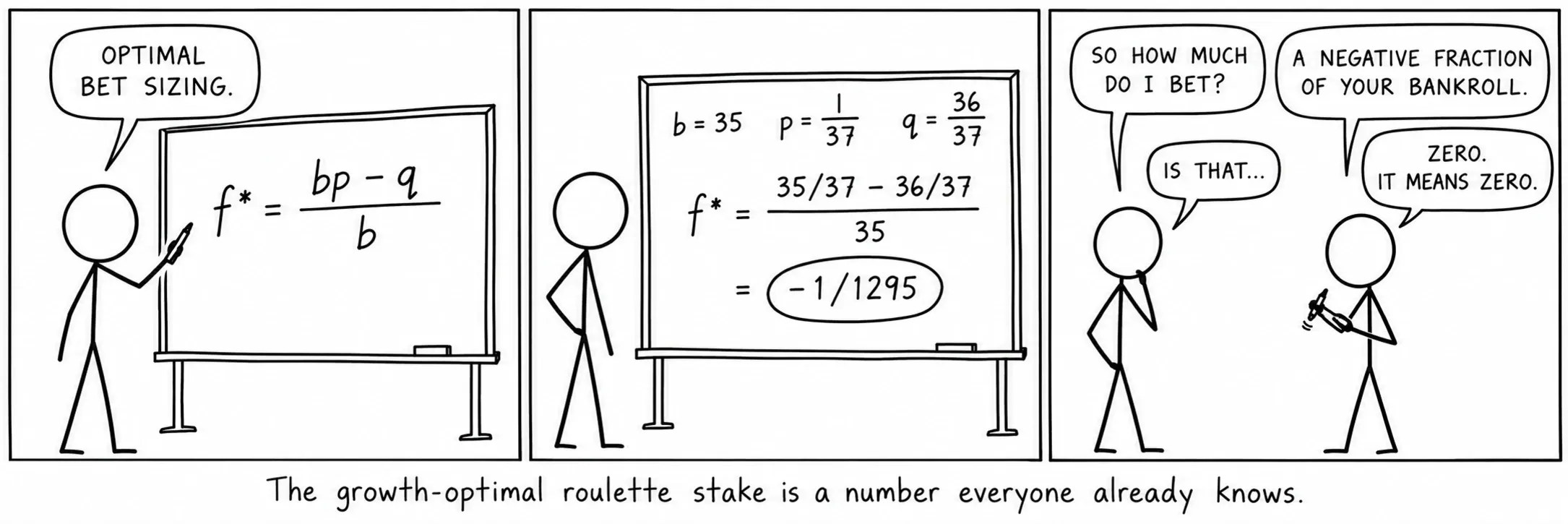
वृद्धिका लागि इष्टतम रूलेट बाजी रकम सबैलाई पहिले नै थाहा भएको नम्बर हो।
स्रोतहरू
- Kelly, J. L. “A new interpretation of information rate.”
- Breiman, L. “Optimal gambling systems for favorable games.”
- Thorp, E. O. “Optimal gambling systems for favorable games.”
- Thorp, E. O. The Mathematics of Gambling.
- Epstein, R. A. The Theory of Gambling and Statistical Logic, 2औँ संस्करण।
- Taylor, D. G. Games, Gambling, and Probability: An Introduction to Mathematics, 2औँ संस्करण।
- Ethier, S. N. The Doctrine of Chances: Probabilistic Aspects of Gambling.
- Haghani, V. & Dewey, R. “Rational decision-making under uncertainty: observed betting patterns on a biased coin.”