मिथक: सङ्ख्याको पालो आएको छ
“150 घुमाइमा सत्र आएको छैन। यसको पालो छ।” छैन।
On independent uniform single-zeroपाङ्ग्राशून्यएउटै हरियो खोप जसलाई कुनै समान-रकम, दर्जन वा स्तम्भ बाजीले छोप्दैन; हाउस एजको स्रोत। अर्को नाम: एकल शून्य, 0।पूरै पढ्नुहोस् → spins, a number’s chance on the next spin remains 1/37, however long it has been absent. Calling it “due” mistakes a long-run proportion for a promise about the next result.
दाबी
क्यासिनोहरूले पछिल्ला 20 देखि 500 नतिजा देखाउँछन् र केही समय नआएका “चिसा” संख्या प्रायः चिन्ह लगाउँछन्। खेलाडीले पट्ट पढ्छन्, 17 150 घुमाइदेखि अनुपस्थित रहेको देख्छन् र यसको पालो हुनैपर्छ भनेर बाजी लगाउँछन्। तर्क यस्तो हुन्छ कि लामो अवधिमा हरेक संख्या 1/37 समय आउँछ, त्यसैले पछाडि परेको संख्या समात्नैपर्छ।
किन गलत छ
In the independent uniform model, the next spin has the same probabilities whatever the recorded history. The law of large numbersगणितठूला सङ्ख्याको नियमपरीक्षणको सङ्ख्या बढ्दै जाँदा स्वतन्त्र नतिजाको औसत अपेक्षित मानतर्फ अभिसरण हुन्छ।पूरै पढ्नुहोस् → concerns proportions over growing samples; it does not require a missing number to appear more often later. A fixed past gap can become small relative to the total without being repaid.
किन सही जस्तो लाग्छ
किनकि जीवनका अरू सबै भागमा अनुपस्थितिले आगमनको भविष्यवाणी गर्छ: बीस मिनेट नआएको बस अर्को पाँच मिनेटमा आउन बढी सम्भावित हुन्छ। त्यो बस तालिकामा चल्ने भएकाले हो। रूलेटको तालिका हुँदैन; यससँग सम्भाव्यतागणितसम्भाव्यतानतिजा हुने मौका, 0 देखि 1 वा 0% देखि 100% सम्म। एउटा सङ्ख्या: 1/37 = 2.70%।पूरै पढ्नुहोस् → हुन्छ, र सम्भाव्यता कोटा होइन। संसारका अधिकांश कुराका लागि अन्तर्ज्ञान सही र पाङ्ग्राका लागि गलत छ।
परीक्षण
Use a simulation to compare a number selected after a long absence with a number selected in advance. Under independent uniform spins, both have the same next-spin probability. Finite samples will differ, sometimes substantially.
Real-world data can also be used to investigate bias or dependence, but that requires a defined test, enough data for the effect being studied and independent validation. A “hot” or “cold” label alone establishes neither.
उल्टो मिथक
“It is hot, so it will keep winning” also lacks support under the independent uniform model. For any selected number, the probability of at least one hit in the next 37 spins is 1 − (36/37)^37, about 63.71%. That is a theoretical probability, not the guaranteed result of a short demo session.
प्रश्नहरू
खेलाडीले माग्ने भएकाले देखाउँछ। पट्ट सही तर निरुपयोगी छ।
(36/37)⁵⁰⁰ ≈ 0.0001%: दुर्लभ, र अर्को घुमाइमा अझै 1/37। एउटै पाङ्ग्रामा यो भइरह्यो भने त्यो झुकावको प्रश्न हो, र उत्तर त्यो संख्याबाट जोगिनु हुन्थ्यो।
आउँदैन।
हास्य-विराम
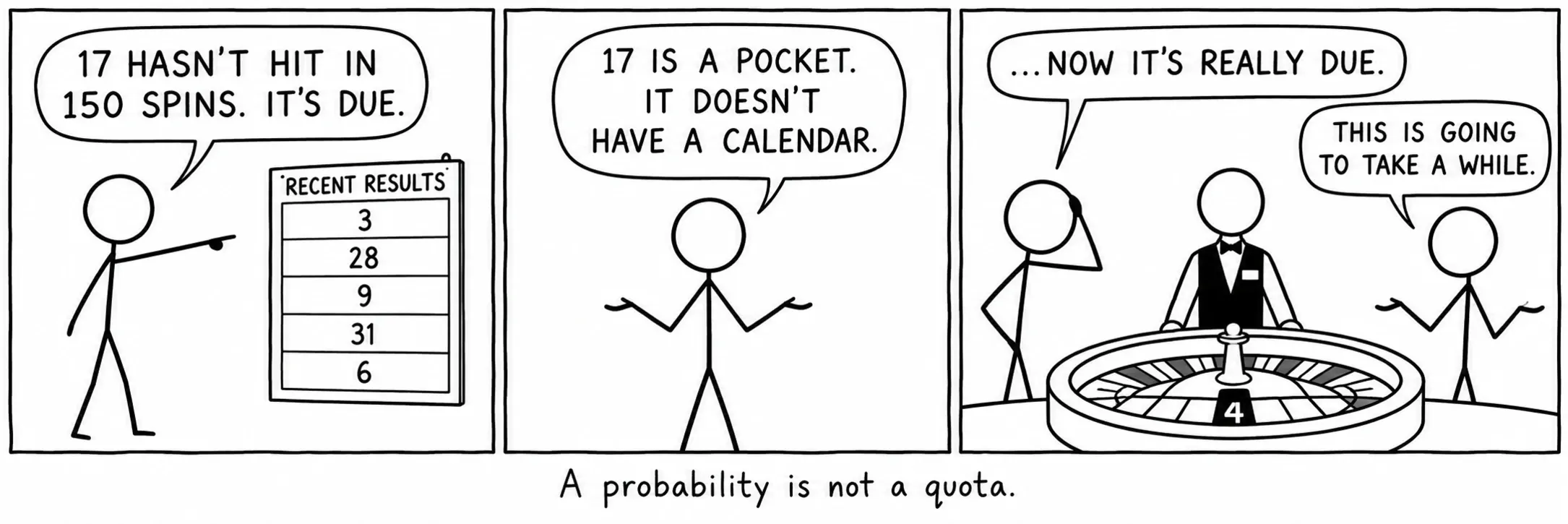
सम्भाव्यता कोटा होइन।
स्रोतहरू
- Feller, W. An Introduction to Probability Theory and Its Applications, Vol. 1.
- Ethier, S. N. The Doctrine of Chances: Probabilistic Aspects of Gambling.